
Why Not Permaculture?
Why not Permaculture?
We’re an industry of ecologically-inclined planners, designers, farmers, businesspeople, and practitioners. Many of us are deeply familiar with the principles and ethics of permaculture, but we don’t use the word. Permaculture centers on sustainable human habitats, and puts language to interacting with the natural world in a way that provides for human needs while healing degraded landscapes – both physical and social. While an entry point into ecological planning for many, permaculture carries ideological pretext, clouding the efficacy of its guiding principles. Those keen on permaculture often find us at Propagate, though we’ve never publicly used the term. We’ve taken the opportunity to be more specific: we plant trees on farms with the goals of profit and ecological benefit. And permaculture, like many domains, informs us but does not dictate our actions. Let us explain.
First, what is permaculture?
Permaculture looks to nature for guidance before it leans on technology. Its currency is often social and experiential capital, and it does not emphasize financial benefit. It has a “do no work” mantra, which really means: do the work up front to design out strenuous and repetitive physical tasks – and a “lazy gardener” notion attracts creative environmentalists that are more interested in design and aesthetics than they are in ongoing maintenance.
Permaculture offers common-sense design principles that can be applied to any agro-ecosystem, such as:
Start with the Big Picture, and then Refine (patterns to details)
Obtain a Yield
Each Element Performs Multiple Functions
Catch and Store Energy
Creatively Use and Respond to Change
Accept Feedback and Apply Self-Regulation
Permaculture also urges us to:
Use Small and Slow Solutions
Use and Value Diversity
Integrate Rather than Segregate
Use Edges and Value the Marginal
Permaculture trumpets complexity and diversity before efficiency and effectiveness, and in practice the “Obtain a Yield” principle is often de-prioritized and ambiguous, eclipsed by “Small and Slow solutions.” On a small scale this is palatable, but let us name it.
The physical facets of permaculture include diverse orchards known as “food forests,” composting and biological soil fertility, water harvesting, and natural & energy-efficient buildings. These facets are highly visible, and thus get a lot of attention.
Permaculture has a strong social layer, and thus differs from general organic farming and homesteading. It emphasizes consensus decision making, resilience through relationships, teaching & education, and skill-share economies. The “fair share” or “return of surplus” ethic is antithetical to hoarding wealth (no harm no foul). Permaculture is not inherently leftist by any means – but compassion for people and ecosystems, idolizing nature as a teacher, and centering creativity and aesthetics generally maps onto the personality traits that most strongly correlate with left wing orientation. Permaculture is very Rousseau, but so too has a Hobbesian-Libertarian contingent, allured by self sufficiency.
The History and Evolution of Permaculture
Permaculture evolved out of conversations between Bill Mollison (while lecturing at the University of Tasmania) and David Holmgren, who was completing his degree in Environmental Design at the Tasmanian College of Advanced Education. Mollison had a background in wildlife biology, but also in the trades: forestry, logging, and fishing. He gradually became an environmental activist and taught environmental psychology and biogeography. Nearly 30 years younger, Holmgren grew up in suburbia with parents who were social justice activists and bookshop owners. The book “Permaculture One” emerged from Holmgren’s undergraduate thesis, on which Mollison advised.
The field evolved over 20-30 years, and it’s likely that 400+ books have been written about permaculture, across all languages, in part because the creative intellectuals that permaculture attracts like to write books. But permaculture was starving for pragmatism and processes. There were too many disparate parts, generalized guidance, and “hacks.” For a philosophy rooted in social benefit, much of permaculture wasn’t sufficiently grounded in human decision making and the relative permanence of interventions in agricultural communities and landscapes. David Holmgren saw this and emphasized the principle of “Accept Feedback and Apply Self-Regulation” – and has continued to successfully apply many permaculture principles to suburbia and beyond. Mollison was apparently less keen on feedback, and was not one for agronomy, business, economics, and the financial viability of farms, which is a mainstay of our work at Propagate. 17 years before he died in 2017, Mollison asked Darren J. Doherty, an Australian farm planner, to write a book on processes in Permaculture, to lend order to the chaos of nature.
Doherty, together with Bulgarian autodidact and polymath Georgi Pavlov, and illustrator Andrew Jeeves (who also illustrated Mollison's magnus opus, 'Permaculture: A Designers' Manual'), is writing The Regrarians Handbook, a 10-layer encyclopedic guide to facets of agricultural landscape planning. The Regrarians Handbook builds on P.A. Yeomans’ Keyline Scale of Relative Permanence, adding the Holistic Management component from Allan Savory, along with farm Economics and Energy. The handbook goes beyond theory, and is centered in pragmatic regenerative agriculture practices from around the world.
Why Not Permaculture?
We stray from permaculture because it serves as a catch-all term for everything we’ve touched on, and there’s usually an opportunity to be more specific in our language. Are we referencing syntropic food forests and their biophysical processes? Or are we keen to talk about food sovereignty and food security? Natural building that relies less on fossil fuels? Neighborhoods that prioritize green space and experience-based vitality? For a few decades, Permaculture was the term, because a lot of these practices were nascent and didn’t have enough momentum on their own. Interest between them was highly correlated, and one umbrella term was useful for broad-spectrum marketing. Permaculture is also often a loaded term in the human-ecology space, in part because of its opaqueness. Folks avoid using the word for the same reason strict vegetarians say “plant based,” because of the assertive-activism-of-a-vocal-minority associated with the word “vegan.”
In the spirit of “integrate rather than segregate,” regenerative agriculture and agroforestry must be approachable and actionable for a much broader array of land managers than the creative intellectuals that are its early-adopters. Wildlife habitat, water quality, flood mitigation, meaningful and durable rural employment, and education in applied science can be (and must be) an integral part of society, free from ideology. “Permaculture” is going to manifest differently in Mexico than it will in Massachusetts or Mississippi, influenced by climate, culture, and standard of living. As we do with engineering, medicine, or psychology, we adopt the relevant facets of the domain without treating it as gospel.
Where does Permaculture land? What does Propagate do?
Permaculture is a great fit for businesses and organizations with a social mission, but it misses the mark for production agriculture. Industrial farmland in The United States and much of the developed world is managed by mechanically-inclined farmers, and rural flight has pushed the profession toward mechanization rather than people-orientation. Creative extroverts are drawn to cities. But permaculture does present an opportunity to meld creativity with agriculture, and success stories tend to be highly people-focused. Permaculture hostels, eco-lodges, afterschool programs, cafes, music venues, and nature education seem to thrive. And alas these enclaves are not a direct substitute for industrial corn in rural America.
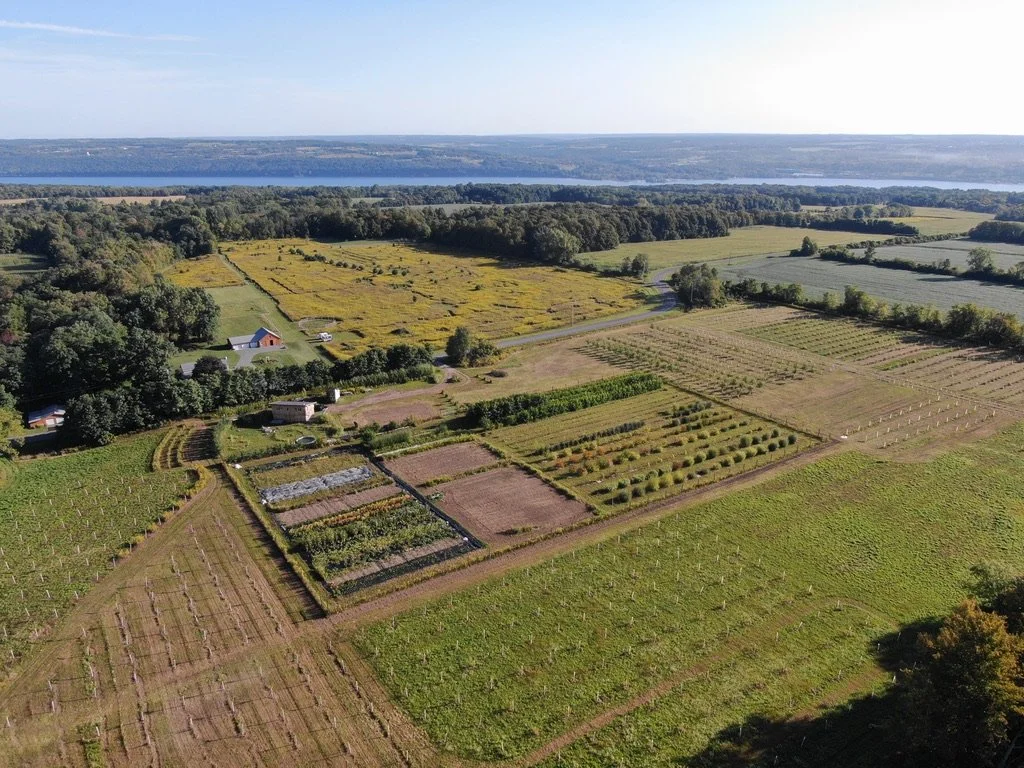
Agroforestry is indeed a substitute for corn, as it is a method of managing large landscapes. Fret not if a tree planting does yet suit your biodiversity requirements, as it’s easy to add complexity to standardized landscapes. We can garden some of the world, i.e. the space right outside our doors. But land management across broad landscapes needs pragmatic solutions. In our personal lives, we plant and manage food forests – growing goumi, asian pears, seaberry, and pawpaw. We host community dinners, send our kids to Waldorf school, and are deeply acquainted with americana and folk music. And professionally, we plant manageable agroforestry on large acreage.
If you’d like to work with us at Propagate, we offer farm planning, improved tree stock, ground preparation, and tree planting services. We run agroforestry courses in person and online. And we create a plethora of free content. We’ve planted over 2,000 acres of agroforestry, and we’d love to plant more with you. And we’re happy to talk to you about permaculture if that is what inspires you.